
Paul Nordberg
My activities & loves
Paul Nordberg
My activities & loves
The records and illustrations here cover some of the more common macrofungi – mostly mushrooms – of Ipswich, Essex County and the surrounding North Shore of Massachusetts. The list does not pretend to be comprehensive or authoritative. Rather, like its sister page on lichens, it reflects the ongoing efforts of an amateur to learn about a different form of life.
I expect to revise early entries as my knowlege grows and I discover the need for corrections and clarifications.
The dates shown reflect the time of field observation, not of posting here.
I deliberately do not address edibility or toxicity here.
I welcome comments and questions.

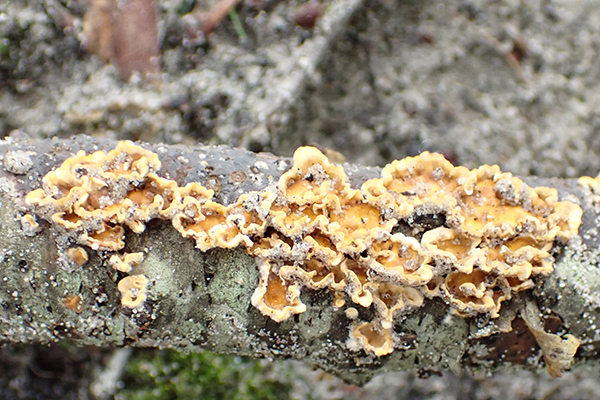
Stereum complicatum offers some welcome coloration. It is widespread in this area. Its common names include "crowded parchment" and "violet curtain crust." It's not clear how those fit with the appearance of the mushroom. I would have said that this specimen is orangish with a pale yellow border. I've seen similar growths that are closer to a violet palette, but I am not sure if they are considered the same species.
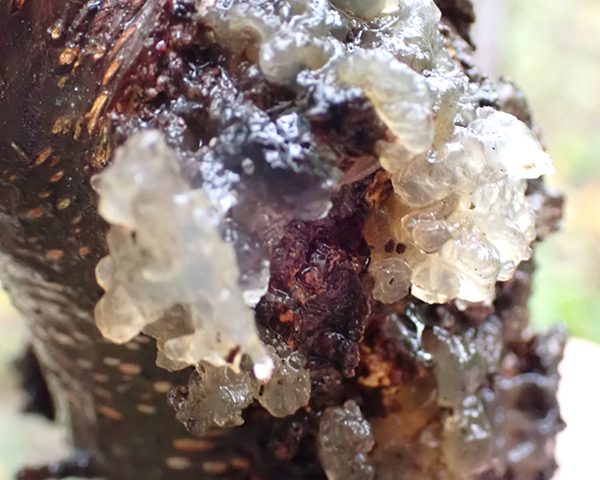
I am including jelly fungi here. They do not fit the common notion of "mushroom." Mushroom references deal with them peripherially if at all. Still, they are macrofungi, i.e. of visible size.
This one is the crystal brain, or granular jelly roll (Myxarium nucleatum). It is unusual among land organisms in being transparent, or translucent, as jellyfish are in the sea.
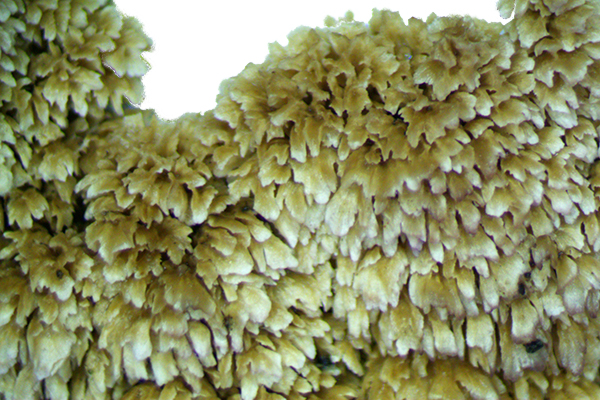
The name of the milk-white toothed polypore (Irpex lacteus) is not far from reality: it is clearly toothed, with tips that are whitish.
It is by all accounts, including mine, very common.
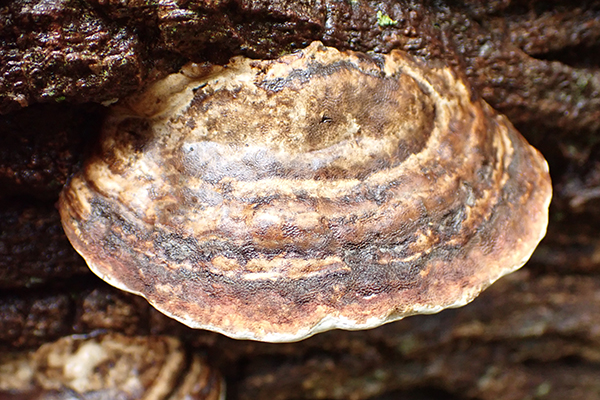
Artist’s conk (Ganoderma applanatum) is an incredibly tough growth. I had quite a bit of difficulty in detaching a specimen to take home. It resisted even woodworking tools in my basement shop.
Wikipedia notes –
A peculiarity of this fungus lies in its use as a drawing medium for artists. When the fresh white pore surface is rubbed or scratched with a sharp implement, dark brown tissue under the pores is revealed, resulting in visible lines and shading that become permanent once the fungus is dried.
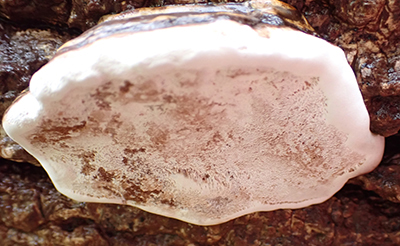
The lower surface, which was a little dirty in this photograph, is very white. The interior mass, once I managed to saw through a section, was very dark.
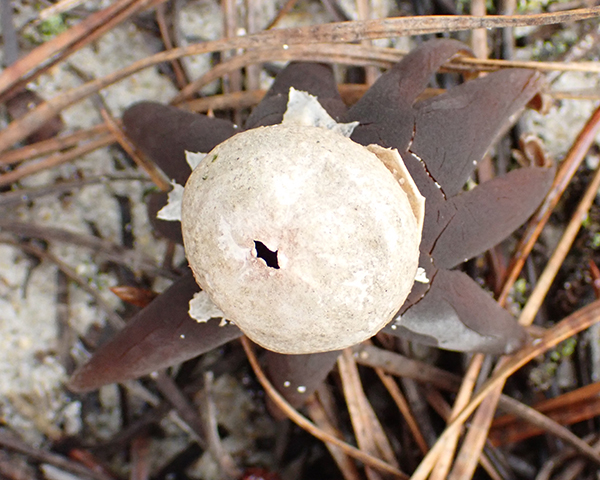
Smith's earthstar (Astraeus smithii) is a relatively new designation, proposed in 2013. Perhaps not all have accepted it; there seems to be more than the usual amount of variability in what names people give to the growths at the Crane Estate.
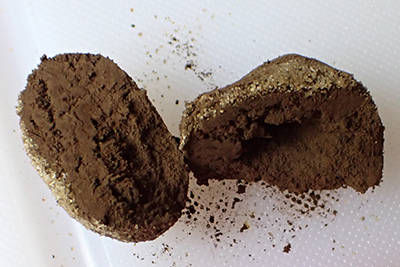
The ripe body has a very small pore hole, which I won't try to show here, to release its spores. They are dark brown at maturity, as is their shell.
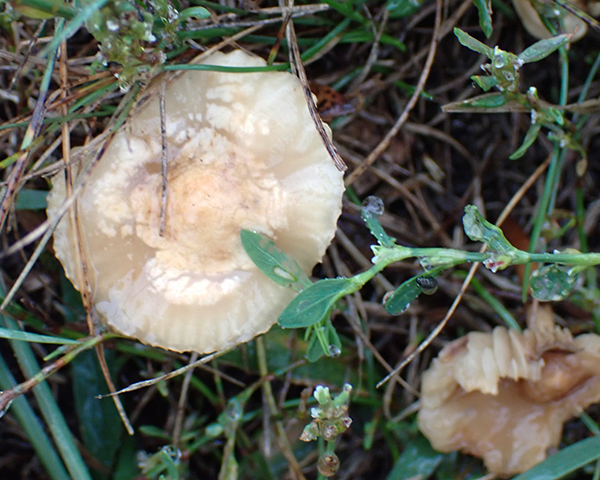
Amid all the rapid evolution in taxonomy in this era of molecular genetics, it is interesting to note that the identify of the fairy ring mushroom (Marasmius oreades) was established in 1836. The name "fairy ring" came, I read, came from the ring-shaped patterns the mushrooms often formed. Google reports –
The name Marasmius comes from the Greek word marasmos (μαρασμός), which means "withering" or "wasting away."
This etymology perfectly describes a unique characteristic of mushrooms in this genus. Unlike most other mushrooms, which rot and decay when they dry out, Marasmius species wither up but do not rot. When it rains again, they can completely revive, absorb moisture, and continue releasing spores. This remarkable survival trait is known as revivescence.
The specimens shown here were part of a handful I noticed in a neighbor's yard after three days of rain. A couple of days later, when the rain had ended and things began to dry up, I could find no trace of them there.
* * *
The lawn habitat is typical. Note the light coloration with a bit of bump in the center. The spore print is white. Bits of the gills are visible in the lower right. They are barely attached to the stem, which is straight and tough.
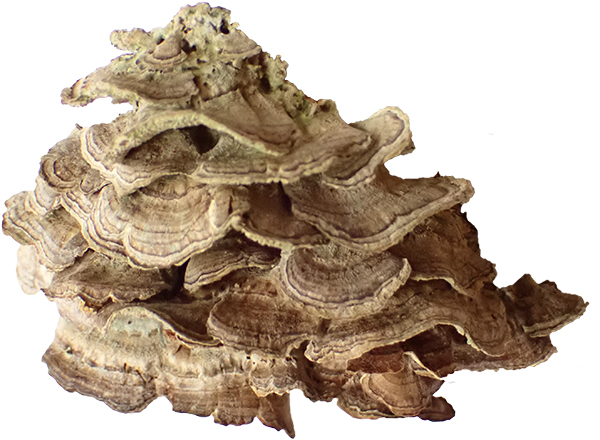
Timothy Baroni cites the violet-toothed polypore (Trichaptum biforme) as "easily the most frequently found species in a hardwood forest because of its aggressive saprotrophic nature to recycle dead, decaying hardwoods." Others agree. So do I. I am very used to seeing it.
* * *

This particular specimen is a bit bedraggled, with a fairly dull color palette. The toothy underside (to the left) perhaps could be described as magenta. MushroomExpert reports the species color as "fading to buff or brownish in age."
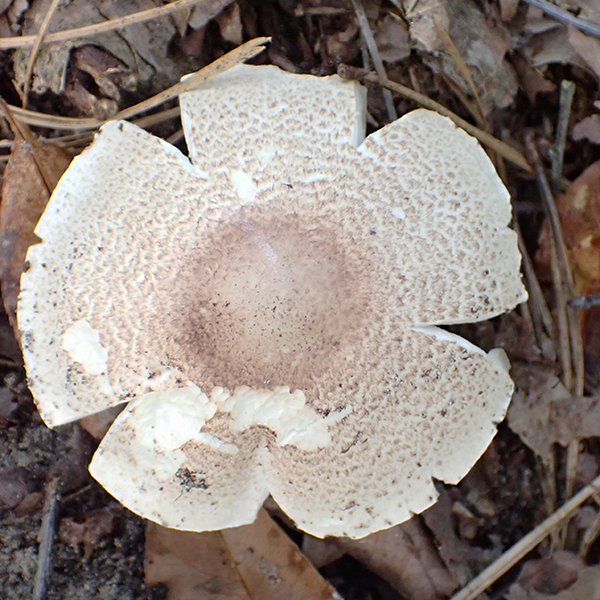
My newly-acquired copy of Baroni's Mushrooms of the Northeastern United States quickly enabled reasonably confident identification of this specimen, which I was struggling with before. Its appearance at a glance is certainly unremarkable. It is, I find, the scaly (or blushing) wood mushroom (Agaricus sylvaticus).
* * *
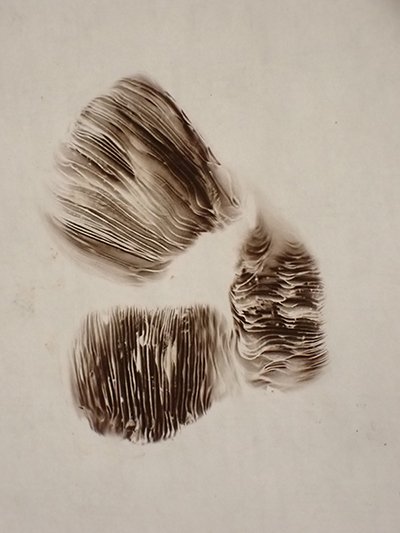
My specimen matches Baroni's notes, in thumbnail: "Cap with contrasting brown scales over white ground color; stem white becoming grayish, with persistent membraneous ring; flesh turning bright red when exposed."
And I am learning to appreciate the ease and value of spore prints, in this case "chocolate or purple-brown," as expected.
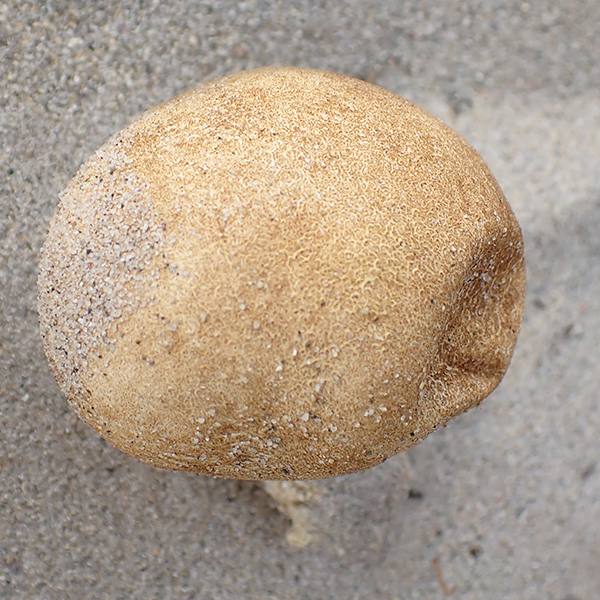
This growth falls into a loose group of "earth ball" mushrooms, so called because they are mostly underground and, like the better known "puffballs," blow out their spores into the air. Specifically, it is Scleroderma septentrionalis = hard-skinned + of the north.
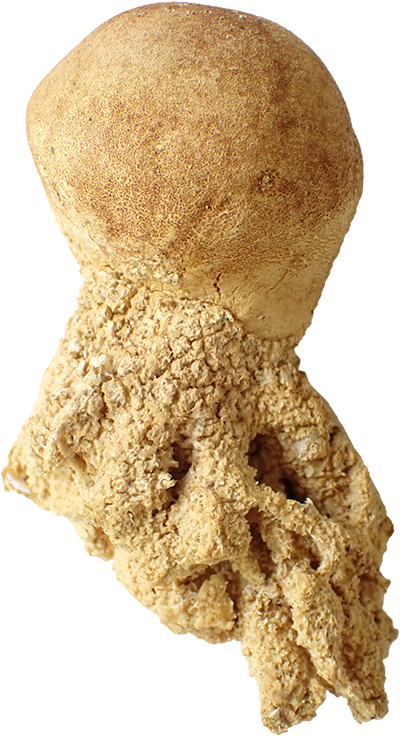
The below-ground portion looks like mutant roots suitable for a witch's brew. Properly speaking, this section is a pseudostipe, actually "a dense collection of whitish rhizomorphs that go deep in the ground to keep it secured in the sandy soil." The species seems to have an affinity with pines; or perhaps the taxa are simply among the few that can survive in such nutrient-poor habitats.
I find it interesting that S. septentrionale, like the "reindeer lichen," Cladonia rangifera, is found especially in sand dunes of this area and in Finland. Surely that is more than a coincidence – but how did it happen?
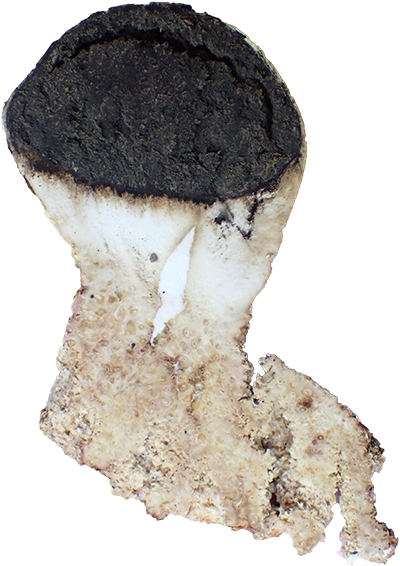
The dark interior spore section of the fungus is visible in a sliced view.

Fortune continued to smile on me in the identification of my second mushroom specimen. It is the birch polypore (Fomitopsis betulina). Being very well-behaved and trying to live up to its name, it grew on a birch tree. And I had learned early in browsing through the guides that many common tree-trunk growths were called polypores = Greek πολυ (many) + pores, which they have rather than gills for dispersing their spores.
The only wrinkle is that with modern molecular genetics, genus and higher groupings are being rearranged, so that Polysporus betulinus became Piptoporus betulinus and then Fomitopsis betulina, while the species-level identity remained stable. Such nomenclature adjustments among fungi are common.
* * *
MushroomExpert notes, "Anyone who has spent time in birch woods has seen Fomitopsis betulina on dead birch trees and logs, or occasionally on still-living trees. The species is an attractive polypore, easily recognized by its habitat on birch wood and the fact that the cap folds over to make a distinctive, smooth rim around the pore surface."
The normal cap diameter is 5–25 cm across and 4–10 cm deep. This specimen measures out at 25 cm across and 15 cm deep. Upon slicing, its flesh is white and firm, as expected.
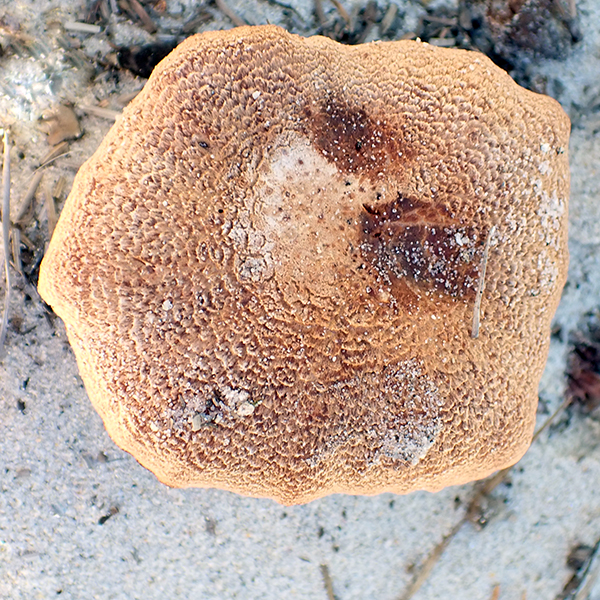
I have had beginner's luck in identifying the first specimen I gathered. Initially, it appeared quite nondescript: a pale brown growth that fit the typical size and cartoon shape for "mushroom."
Its habitat in sand, however, was unusual. Most often, mushrooms grow on or very close to their nutritive sources; they are not solitary desert organisms. The distinctive home enabled ready identification via a Google AI search for "mushrooms in sand in coastal Massachusetts." A few minutes' further research confirmed the taxon as Laccaria trullisata (perhaps more correctly spelled as trullissata).
* * *
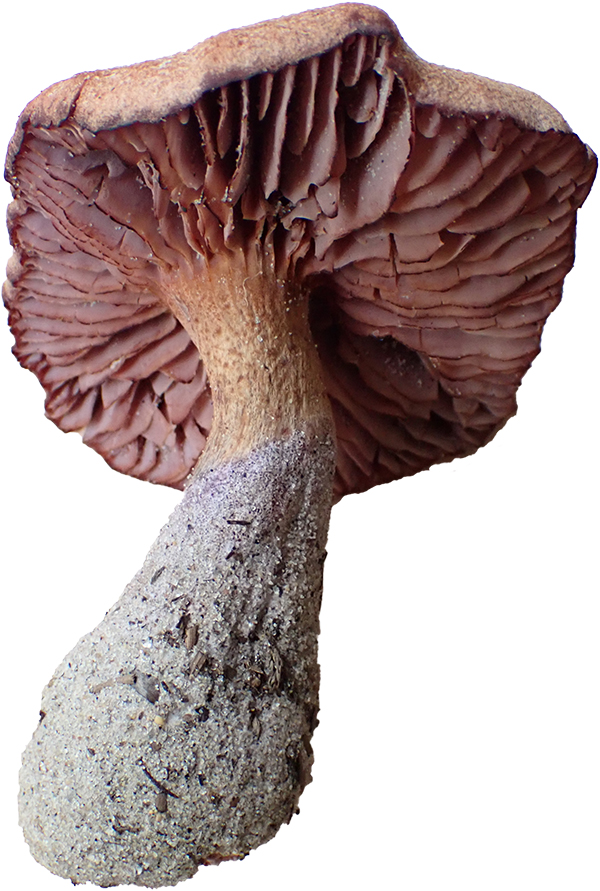
Michael Kuo's MushroomExpert offers useful notes: "This interesting species of Laccaria can be found in sand dunes on the East Coast, the Gulf Coast, and along the Great Lakes. Its habitat and its thick, purple gills distinguish it from just about anything else"
Alphabetical by scientific name
© 2026 Paul Nordberg